
PalmSens MultiPalmSens4
The MultiPalmSens4 is a flexible multi-channel potentiostat, galvanostat and impedance analyzer which you can fully tailor to your requirements and budget. The MultiTrace software allows for using each channel individually or simultaneously or running a sequence of automated tasks on each channel. Each channel provides an additional auxiliary port for controlling peripherals or monitoring temperature or other analog signals. By enabling synchronization of channels and adjusting the setup of your cables, you can use the MultiPalmSens4 as a polypotentiostat. This means you can use multiple working electrodes, one counter and one reference electrode in the same cell at the same time. Your working electrodes all perform the same measurement.
The MultiPalmSens4 is customizable and has the options listed below.
Each channel can be configured with:
- ±5V or ±10V maximum potential range
- EIS/FRA with maximum frequency of 100 kHz or 1 MHz max
- Bipotentiostat module for second WE
- iR drop compensation
- Galvanic isolation
Use Lablink to connect your MultiPalmSens4 to your Local Area Network.
The Lablink Hub is a dedicated instrument server that acts as the bridge between your hardware and the local area network (LAN), allowing standard PalmSens instruments to interface with the Lablink platform. This enables multiple users to view and share instruments, see what is in use, reserve channels, access data, and load data into PSTrace for Windows from any computer connected to the LAN. Learn more about it here: PalmSens Lablink Hub
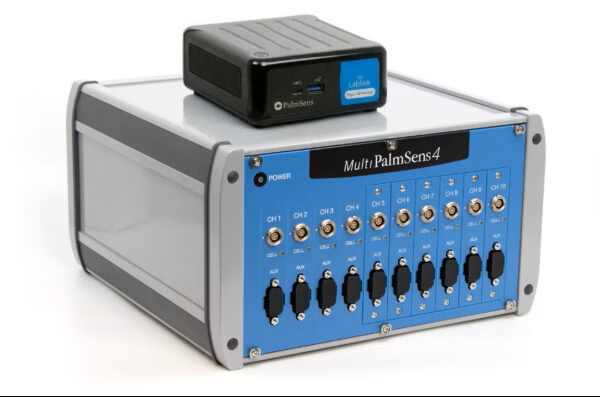
Standard packaging includes a USB cable, crocodile clips, and a shielded cable with 2 mm banana connectors for a working electrode, counter electrode, and a reference electrode for each channel. MultiPalmSens4 channels are available in 6 different options with the specifications that are just right for your needs. MultiPalmSens4 channels are available as a bipotentiostat upon request and a multiplexer extension is available to convert each channel into an 8 or 16 channel instrument. Each channel is capable of running its own independent technique with individual parameters.
Techniques available with MultiTrace Software (included with the instrument)
Voltammetric techniques
▪ Linear Sweep Voltammetry (LSV)
▪ Cyclic Voltammetry (CV)
▪ Fast Cyclic Voltammetry (FCV)
▪ AC Voltammetry (ACV)
Pulsed techniques
▪ Differential Pulse Voltammetry (DPV)
▪ Square Wave Voltammetry (SWV)
▪ Normal Pulse Voltammetry (NPV)
Amperometric techniques
▪ Chronoamperometry (CA)
▪ Zero Resistance Amperometry (ZRA)
▪ Chronocoulometry (CC)
▪ MultiStep Amperometry (MA)
▪ Fast Amperometry (FAM)
▪ Pulsed Amperometric Detection (PAD)
▪ Multiple-Pulse Amperometric Detection (MPAD)
Galvanostatic techniques
▪ Linear Sweep Potentiometry (LSP)
▪ Chronopotentiometry (CP)
▪ MultiStep Potentiometry (MP)
▪ Stripping Chronopotentiometry (SCP or PSA)
Potentiostatic/Galvanostatic Impedance spectroscopy (EIS/GEIS)
▪ Potential scan or current scan
▪ Fixed potential or fixed current
▪ Time scan
Other
▪ Mixed mode
Minimum of 4 channels must be ordered.
Please contact BASi for your quote today or send the MultiPalmSens4 cofiguration sheet to ec@basinc.com.
Standard MultiPalmSens4 bag includes:
- MultiPalmSens4
- USB cable
- Power supply (12 V AC/DC adapter)
- Sensor cable per channel
- Set of croc clips per channel
- Ground lead with big croc clip
- PS Dummy Cell
- MultiTrace software + manual
- Quick start document
- Three year warranty
General
▪ DC potential range: ±5 V ±10 V
▪ Compliance voltage: ±10 V
▪ Maximum current: ±30 mA (typical)
▪ Maximum acquisition rate: 150,000 points/s
Potentiostat (controlled potential mode)
▪ Applied DC potential resolution: 76.3 μV (18-bit)
▪ Applied potential accuracy: ≤ 0.1% ±1 mV offset
▪ Current ranges 100 pA to 10 mA (9 ranges)
▪ Measured current accuracy: < 0.2% of current (±10 pA ±0.1% of range)
▪ Measured current resolution 0.005% of current range (18-bit, 5 fA on 100 pA range, 0.0025% of 10 mA range)
Galvanostat (controlled current mode)
▪ Current ranges: 1 nA to 10 mA (8 ranges)
▪ Applied DC current: ±6 x applied current range
▪ Applied DC current resolution: 0.0076% of applied range (<10 mA), 0.0038% of 10 mA range
▪ Applied DCcurrent accuracy: < 0.2% of current (±10 pA ±0.1% of range)
▪ Potential ranges: 10 mV, 100 mV, 1 V
▪ Measured DCpotential resolution: 78 μV at ±10 V (1 V range, 18-bit), 7.8 μV at ±1 V (100 mV range), 0.78 μV at ±0.1 V (10 mV range)
▪ Measured DC potential accuracy: ≤ 0.05% or ±1 mV for |E| <9 V, ≤ 0.2% for |E| ≥9 V
FRA/EIS (impedance measurements)
▪ Frequency range: 10 μHz to 100 kHz or 1 MHz
▪ AC amplitude range: 1 mV to 0.25 V rms, or 0.7 V p-p
GEIS (galvanostatic impedance measurements)
▪ Frequency range: 10 μHz to 100 kHz (all configurations)
▪ AC amplitude range: 0.001 * CR to 0.4 * CR rms (<10 mA), 0.001 * CR to 0.2 * CR rms (10 mA)
(CR=current range)
Not showing properly? Click here to view all reference articles.
